
Super Mario Kart
- This article is about the Super Nintendo Entertainment System game. For other uses, see Super Mario Kart (disambiguation).
- "SMK" redirects here. For the manga series, see Super Mario-kun.
| Super Mario Kart | |||||||||||||||||
|---|---|---|---|---|---|---|---|---|---|---|---|---|---|---|---|---|---|
 North American box art For alternate box art, see the related gallery. | |||||||||||||||||
| Developer | Nintendo EAD | ||||||||||||||||
| Publisher | Nintendo | ||||||||||||||||
| Platforms | Super Famicom/Super Nintendo Entertainment System, Super Famicom Box, Virtual Console (Wii, Wii U, New 3DS), Super NES Classic Edition, Nintendo Classic Mini: Super Famicom, Super Nintendo Entertainment System – Nintendo Classics | ||||||||||||||||
| Release dates | Super Famicom: August 27, 1992[1] August 27, 1992[1]Super Nintendo Entertainment System:  September 1, 1992[2] September 1, 1992[2] January 21, 1993[?] January 21, 1993[?] August 30, 1993[3] August 30, 1993[3]Player's Choice: May 20, 1996[4]Virtual Console (Wii): June 9, 2009[5] November 23, 2009[6] April 2, 2010[7] April 3, 2010[8] April 3, 2010[8]Virtual Console (Wii U): June 19, 2013[9] March 27, 2014[7] March 28, 2014[10] August 6, 2014[11]Virtual Console (New 3DS): March 17, 2016[7] March 18, 2016[12] March 24, 2016[13] May 9, 2016[14]Super NES Classic Edition: September 29, 2017[15] September 29, 2017[16] September 30, 2017[17] October 5, 2017[18]Super Nintendo Entertainment System - Nintendo Classics: September 5, 2019[19] September 6, 2019[20] September 6, 2019[21] September 6, 2019[22] September 6, 2019[?] September 6, 2019[?] September 6, 2019[?] September 6, 2019[?]Fully souped up!: May 26, 2021[?] May 26, 2021[?] May 26, 2021[?] May 26, 2021[?] | ||||||||||||||||
| Languages | English Japanese | ||||||||||||||||
| Genre | Racing | ||||||||||||||||
| Ratings | SNES:
| ||||||||||||||||
| Mode | 1–2 players | ||||||||||||||||
| Format |
 Cartridge CartridgeSNES:  Game Pak Game PakWii:  Digital download Digital download Digital download Digital download Digital download Digital download Digital download Digital downloadBuilt-in
| ||||||||||||||||
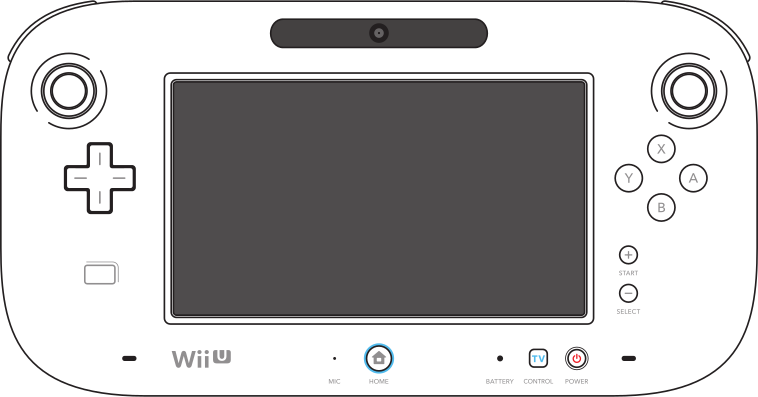
| Input | SNES: Wii:  Joy-Con (horizontal) Joy-Con (horizontal) | ||||||||||||||||
| Serial code | SHVC-MK | ||||||||||||||||
 - Kids to Adults
 - All ages
 - Everyone
 - All ages
 - Three years and older
 - All ages
 - General audience
 - General






- “Where racing becomes an adventure!”
- —Game tagline
Super Mario Kart is a racing game for the Super Famicom and Super Nintendo Entertainment System. The game was first released in 1992 and rereleased in 1996 as a Player's Choice title, being the first title in the lineup. Unlike the other racing games at the time, which focused on single-player racing with more complicated tracks, Super Mario Kart was focused on two players and was designed to be an easy and intuitive "pick up and play" experience that heavily involves the use of acquiring weapons on an obstacle course-like track to impede another player's progress. The development of a one-on-one Battle Mode was invented as another way to enjoy the competitive aspects of the game. Another notable aspect of the game is its Mode 7 graphics, where the game simulates a 3D plane by rotating and scaling a background graphic on a scanline-by-scanline basis, allowing players to simulate driving in a 3D environment. Much of this game is heavily based on Super Mario World, with both graphics and general themes being taken from that game; this includes sprites reusing Super Mario World's assets and music cues rearranging its melodies.
Super Mario Kart was rereleased on the Wii's Virtual Console in 2009–2010, on the Wii U's Virtual Console in 2013–2014, and on the New Nintendo 3DS's Virtual Console in 2016. It is one of the 21 titles included on the Super NES Classic Edition and is one of the 20 launch titles for Super Nintendo Entertainment System – Nintendo Classics, which also released a special version titled Super Mario Kart: Fully souped up! with 150cc and the Special Cup unlocked on May 26, 2021.
Gameplay[edit]

Players select a Super Mario character out of a roster of eight characters with which to race (or battle in Battle Mode) against opponents; each racer has their own stats which determine how they control, though these are not displayed in-game. Players then race or battle against their opponents, depending upon which game mode is chosen. Integral to the gameplay is the item system, where players can pick up items from Question Blocks clustered around parts of the track. The item obtained is dependent on the player's position in the race. For example, players farther behind obtain stronger items such as the invincible, speed-raising Star or the Lightning that can shrink all racers, while players farther ahead receive the basic Banana Peels and Green Shells items. Question Blocks get depleted whenever a player runs over them, and they do not respawn their items until all Question Blocks in the track have been depleted.
At the start of the race, players can rev their kart up for a boost, though if they rev up too much, they begin the race by accelerating much slower. Players can hop if they press either  or
or  . If they hold the button after hopping while holding either left or right, they can power slide, which enable them to drive through harder turns while losing less speed than steering normally through them. A slight drift is also possible by hopping and only holding either the left or right button. While karts in this game can brake with
  , they cannot go in reverse: players need to perform a U-turn or hop around to go backwards. Some tracks feature water that players can fall into: if players fall into these areas, they are able to move around for a little while before eventually being picked up by Lakitu. Players immediately get rescued by Lakitu if they fall into pits or into lava, however.
While driving the course, coins can be picked up, which increase the player's top speed as well as shield them from other racers. If a player runs into another racer while they have zero coins, they spin out; however, if a player runs into another racer while they have several coins, they simply lose one coin while still being able to continue driving. Having ten coins gives the player the maximum amount of speed they can possess, though they are still able to collect additional coins without gaining any additional speed. Players start each race with a number of coins depending on their rank: first and second start with two coins, third and fourth start with three coins, fifth and sixth start with four coins, and seventh and eighth start with five coins. Players lose four coins if they are hit with an item, they lose two coins if they are picked up by Lakitu by falling off the track, and they lose one coin if they bump into another racer. The number of coins found on each course varies from one course to another.
Three speeds are available: 50cc, 100cc, and 150cc. 50cc is the slowest and therefore easiest difficulty while 150cc is the fastest and hardest engine class that must be unlocked by clearing all cups in the 100cc engine class which has a medium level of speed and difficulty. Vehicles in all modes outside of Mario Kart GP use 100cc engines.
The game is always split in two screens. The top screen is the main screen that players see the gameplay in while the bottom screen displays an overhead map, displaying progress of all characters. If players press  or
or  , they can switch the overhead map to a backwards view. When two players are playing, the bottom map is replaced by the second player's screen.
If players want to delete their save data, they need to press , , , and  at the title screen. If players want to delete just Time Trial records, they can go to the course records they wish to delete and press the same button combination.
Online gameplay was supported via the XBAND network. It was discontinued in 1997.
Controls[edit]
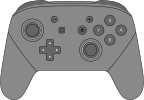
The Wii U and Nintendo Switch versions' controls can be customized; their respective columns display the default mappings.
| Action(s) | |||||||
|---|---|---|---|---|---|---|---|
| SNES | Wii (Classic Controller) | GameCube Controller | New Nintendo 3DS | Wii U | Nintendo Switch (Dual Joy-Con / Pro Controller) | Nintendo Switch (Single Joy-Con) | |
| Change option during the Menus/Steer | 
|
 / / 
|
 / / 
|
 / / 
|
 / / 
|
 / / 
|

|
| Use items, stop Item Roulette |
|

|

|

|

|

|

|
| Accelerate / Rocket Start | 
|

|

|

|

|

|

|
| Switch view | /
|
 / / 
|
 / /  [a] [a]
|
 / / 
|
 / / 
|
 / / 
|
 / /  + + 
|
| Brake |
|

|

|

|

|

|

|
| Jump / Drift | /
|
 / / 
|
 / / 
|
 / / 
|
 / / 
|
 / / 
|
/ 
|
| Pause / Select | 
|

|

|

|

|

|
+
|
- ^ Virtual Console version only
Game modes[edit]
Mario Kart GP[edit]

The Mario Kart GP is the main mode in Super Mario Kart. Here, up to two players can race against seven or six other CPU-controlled opponents in a five-course cup; they first start out in 8th place and must make their way to the top position; players keep their position for the next race if they end in that position. The top four players receive points based on their ranking: 1st place gives the player 9 points, 2nd place gives the player 6 points, 3rd place gives the player 3 points, and 4th place gives the player 1 point, while 5th place, 6th place, 7th place and 8th place give the player 0 points. Players who rank 5th or below lose one of 3 lives. If all players rank 5th or below, the race must be tried again. If the player ranks 5th or below without any lives left, the game is lost. A single extra life can be earned by placing in the same position three times. The maximum score in a GP cup is 45 points, obtained by winning five times. The three best drivers move on to the award ceremony where they receive their trophies. 3rd place gives the player a bronze trophy, 2nd place gives the player a silver trophy, and 1st place gives the player a gold trophy (the player can watch the ceremony only when they place first: however, a prototype version has animations for second and third). If the player ranks 4th or below by the end of the cup, their character is placed at the side of the podium and cries with their back facing the screen which displays text that says, "(character's name) came in (number) place. Try again." Each race is five laps long (with Lakitu appearing on the left side of the player holding the start signal and the lap count signs).
If players beat all of the cups in the 100cc engine class, the message "Excellent driving! You are now a Super Mario Kart expert." pops up, thus officially telling players that they have completed all four of the cups. If the player wants a harder challenge, they can now replay through the game in the 150cc engine class. If players beat all of the cups in the 150cc engine class, the same message as before pops up. If the player wants a more difficult challenge, they can hold and at the character selection screen. This makes the character permanently small as if under the effect of a Lightning or Poison Mushroom until the player presses the buttons again.
Time Trial[edit]
This one-player mode have the player to race through five laps of the selected track the fastest they can without items or coins in the 100cc engine class. The five lap times are recorded which are then combined to make the total time, as well as the fastest lap time and the characters used, for each track. By pressing on the second controller, a computer-controlled opponent can be chosen to race against.
If the player enters the cheat code , , , , , , , , on the cup selection menu in Time Trial, the Special Cup is unlocked. In the Japanese version, a Boo sound is heard upon successfully inputting the code.[23]
Match Race[edit]
This mode is two-player only: the players can race each other like in GP, except CPU racers do not appear and players can freely choose the track to race in. Players start with three coins each. Bullet Bills slide around the courses as well, and coming in contact with one results in the kart spinning out and the object disappearing as if it were a Green Shell. The game keeps track of wins and losses of each player.
Battle Mode[edit]

- Main article: Balloon Battle
A two-player exclusive mode where players combat each other with items in an arena. The goal is to eliminate the opposing player's balloons, which are represented by colored spheres rotating around the character (player 1 is blue, and player 2 is red). Each player has three balloons that cannot be recovered. The first to pop all the opponent's balloons wins.
Characters[edit]

Super Mario Kart has eight available drivers, divided into statistically identical pairs of two. While subsequent Mario Kart games would classify characters based on weight class, in this game other criteria are used. The stats presented here are derived and inferred from the manual. The Bros are average drivers with a high top speed, The Dragon and The Lady have the highest acceleration with low handling, The Showdown have the lowest acceleration with the highest top speed and weight, while The Small Guys have high acceleration and handling, which makes them recommended for beginners. Each pair of characters has different engine sounds for their karts, which reflect their appearances and characteristics. All drivers also have a unique theme music whenever they finish a race with a good position. Yoshi, Bowser, and Donkey Kong Jr. are the only drivers in this game to have their own taunts when surpassing other racers regardless if they are being used by the player or CPU. The others do not have their own taunts and instead the standard beep is heard when surpassing other racers, but can only be heard when used by the player.
This is one of only two Mario Kart games to feature Donkey Kong Jr. as a playable character, the other being Mario Kart Tour, where he uses his two-dimensional sprite from this game.
| Classification | Driver | Acceleration | Top speed | Weight | Handling | CPU item | Description |
|---|---|---|---|---|---|---|---|
| The Bros. Standard Performance |
 Mario |
Average | Very Good | Average | Average | Star | "The Mario Brothers have pretty much the same abilities in cart driving. Mario and Luigi have had a friendly rivalry that goes back to their childhood. You can expect a heated contest between them. When Mario and Luigi are computer controlled, they try to block your path." |
 Luigi | |||||||
| The Dragon and The Lady Fast Acceleration |
 Princess |
The Best of the Best | Average | Average | Not so hot | Poison Mushroom | "At first, you might think that The Princess and Yoshi would have nothing in common (except their fondness for Mario). As it turns out, they have the same driving ability. Both of these racers have very fast acceleration. As enemies, the Princess will toss poison mushrooms in your path, and Yoshi will use eggs to hinder your progress." |
 Yoshi |
Egg | ||||||
| The Showdown High Top Speed |
 Bowser |
Not so hot | The Best of the Best | Very Good | Average | Fireball | "These two drivers have long been Mario's arch enemies. They are both rather hefty, so they have slow acceleration, but their top speed is great! As enemies, look out for Bowser's fireballs and Donkey Kong Jr.'s banana peels. These two really throw their weight around. Stay clear of them!" |
 Donkey Kong Jr. |
Banana | ||||||
| The Small Guys Good Control |
 Koopa Troopa |
Very Good | Not so hot | Not so hot | Very Good | Green Shell | "Neither of these racers have qualities that make them stand out. They are, however, good all around racers with better than average control in corners- they do not skid as easy. These racers are good for beginners who are just learning to race. In the GP race as enemies, Koopa Troopa will drop shells and Toad will place poison mushrooms on the track." |
 Toad |
Poison Mushroom |
Maximum speed[edit]
The Japanese Official Nintendo Guidebook of the game lists the maximum speed in the 100cc engine class in various conditions.[24] This maximum speed is increased by 1 km/h per each coin collected, until 10 coins are collected.[25]
| Maximum speed in the 100cc engine class | |||||||
|---|---|---|---|---|---|---|---|
| Driver | Maximum speed (km/h) | ||||||
| Normal road | Circuits' sand | Choco Island's rocks | Choco Island's mud | Donut Plain's grass | Koopa Beach's water | Vanilla Lake's snow | |
| Mario Luigi |
130 | 84 | 40 | 90 | 82 | 82 | 76 |
| Princess Yoshi |
125 | 88 | 44 | 94 | 86 | 86 | 70 |
| Bowser Donkey Kong Jr. |
135 | 86 | 42 | 92 | 80 | 88 | 74 |
| Koopa Troopa Toad |
120 | 90 | 46 | 96 | 84 | 84 | 72 |
Acceleration[edit]

Performance chart[edit]
The official instruction manual illustrates a chart that details how well characters perform on tracks and their stats. It notes that Toad and Koopa Troopa have the best steering while The Princess and Yoshi steer worse. Another point it mentions is that Toad and Koopa Troopa can get knocked aside by Bowser and Donkey Kong Jr.

Rivals[edit]

Super Mario Kart has a different rival system from the rest of the series (except for Mario Kart: Super Circuit); the rivals contain one very fast driver, one fast driver, one medium driver, one slow driver and three very slow drivers. It is notable that when one of the three slowest drivers gets hit, that kart keeps its place, while when one of the faster cars gets shot, it usually resumes its previous place very quickly unless unable to catch up fast enough before the race ends. For this reason, the drivers (except the human racer) are expected to finish in a particular order if unaffected. Also, if the player tries to hit an opponent, the opponent may jump over